

Download V2 of THE BEGINNER’S GUIDE to
MEP Embodied Carbon
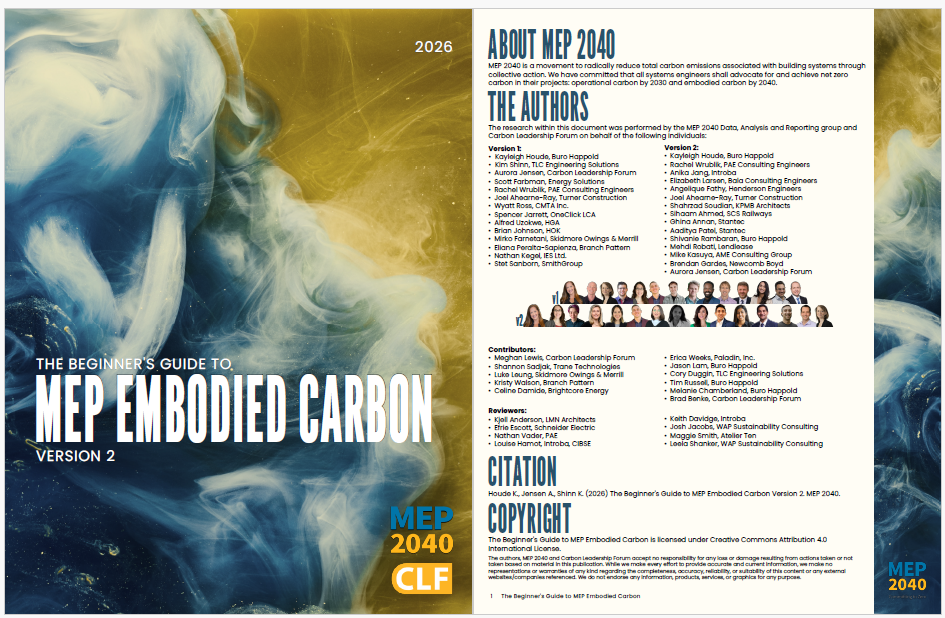
The Beginner’s Guide, V2
Welcome to the Beginner’s Guide to MEP Embodied Carbon v2, an updated, comprehensive resource developed through cross-industry collaboration between MEP 2040 and the Carbon Leadership Forum. With takeaways from the MEP 2040 Whole Life Carbon Pilot study and a year of industry use, this updated guide provides the same lessons from the first version, as well as additional findings, including:
Inclusion of MEP Whole Life Carbon Pilot results by category and life cycle stage (p. 4, 8–9)
Updates to project reporting fields (p. 7)
MEP 2040 reporting workflow (p. 10)
MEP category inclusion comparison across relevant standards (p. 15)
Addition of metric values for piping tables and corresponding Revit formulae (p. 18–23)
Updates to A4–C tables in alignment with ASHRAE/ICC 240P Draft 2 (p. 50–61)
Updates to uncertainty guidance with example calculations and a new uncertainty calculation template (p. 60–61)
New FAQ Section Includes:
Use of the guide outside the United States (p. 64)
Definition and application of site boundaries in reporting (p. 65)
District energy systems (p. 66)
Refurbishment and retrofit projects (p. 67)
Whether you’re integrating MEP systems into your carbon assessments or looking to understand and reduce your systems’ impact, this guide provides practical methodologies to move from measurement to meaningful action. We encourage you to download the guide, share it with your networks, and continue your valuable contributions to reducing MEP whole life carbon.
Downloads
The guide includes:
Detailed MEP BIM takeoff methodologies
Material selection guidance for high-impact systems
Default embodied carbon values for data-poor categories
Category-specific decarbonization strategies
Life cycle calculation breakdowns with uncertainty guidelines
A real-world case study: University of Illinois' Wymer Hall
Actionable steps for all stakeholders
Supplementary Resources
Data Entry Template: The MEP 2040 Data Entry Template helps you to record information for the MEP 2040 Whole Life Carbon Pilot and the MEP 2040 Benchmarking Study. The values in this template have been updated from v1 in the following ways:
Project Data Additions:
On-site EV charging
Detailed Building Use Type
EUI
Addition Floor Area (m2)
Renovated Floor Area (m2)
Whole Life Carbon Data Additions:
New reporting sub-categories, including: Air Handling Units <25 Tons, Air Handling Units >25 Tons, Chillers/Heat Pumps – Air Cooled, Chillers/Heat Pumps – Water Cooled, Cooling Towers, Heat Pumps – Self Contained (PTAC, PTHP, WSHP), Split Systems – Ducted, Split Systems – Ductless, Horizontal Pipe (Exterior) (for Geothermal), Drinking Fountains, Showers, Sinks, Site MEP Required and Optional categories
Refrigerant losses built in per equipment sub-category
Operational Energy Modification:
Reference to BranchPattern CLEAR Tool for optimized operational carbon calculations
3. Uncertainty Calculation Template: This resource helps practitioners understand, quantify, and communicate uncertainty in MEP carbon assessments. It provides a structured way to evaluate how assumptions about material quantities, emissions data quality (EPDs), geographic and technological representativeness, and whole-building parameters influence overall carbon results, translating those uncertainties into a clear percentage impact on project outcomes. In doing so, it supports more transparent decision making, better interpretation of LCA results, and more informed conversations about confidence, risk, and comparability in carbon reporting.
4. Beginner’s Guide Schedules for Revit: This resource helps practitioners to apply the Revit formulae described in the guide by importing the schedules into their Revit project. The schedules include:
Cable Tray
Chilled Beam
Duct
Electrical Circuits
Imperial Pipe
Mechanical Equipment (VAV)
Metric Pipe
Panelboard
Please note that the schedules utilize Project Units, in an imperial model the pipe schedules will both use imperial units and in a metric model the schedules will both contain metric units – the differences are found in the formulae.
Supporting Tools:
1. Piping System and Discipline Result Workbook: A workbook for organizing piping systems by discipline and recording their mass data from Revit before entering it into LCA software. Use alongside pages 17-24 in the Beginner's Guide to MEP Embodied Carbon.
2. Wire and Conduit Estimator: A workbook for organizing all modeled wire lengths by size, to associate with available Environmental Product Declarations (EPDs), as well as scaling wires to their associated conduits and available EPDs. Use this workbook alongside the workflow described on pages 31-32 of the Beginner's Guide to MEP Embodied Carbon.