
The History of the MEP 2040 Challenge & Commitment
Starting in January, 2021, a volunteer group of MEP engineers hosted by the Carbon Leadership Forum (CLF) convened to explore a multi-year, industry-wide campaign to radically reduce embodied carbon and refrigerant emissions related to MEP systems. Planning began in May 2021 with an expanded team. On October 31, 2021, the CLF, led by founder and Executive Director Kate Simonen, announced the Challenge to the MEP 2040 industry in advance of the COP26 Cities, Regions & Built Environment Day in Glasgow, Scotland. MEP firms and supporting organizations responded by signing the Commitment.
Timeline
In January of 2021, a group of CLF members who are systems engineers and designers (focused on Mechanical, Electrical and Plumbing (MEP) systems) gathered with CLF Executive Director Kate Simonen and CLF Director of Collective Impact Andrew Himes to discuss how to galvanize MEP design firms and systems manufacturers to radically reduce embodied carbon in their projects and products. The group was inspired by the SE 2050 challenge from CLF calling for “all structural engineers to understand, reduce and ultimately eliminate embodied carbon in their projects by 2050.”
Beginning in May, 2021, the MEP 2040 team met with CLF staff as an ongoing working group to develop a data-driven commitment for MEP engineering firms to work towards total life cycle decarbonization including embodied along with operational carbon. Recognizing the increased urgency of action, this team set 2040 as their target!
CLF announced the MEP 2040 Challenge in advance of the COP26 Cities, Regions & Built Environment Day in Glasgow, Scotland, October 31, 2021. The Challenge demands more than vague promises by building designers to do better. It requires a set of solid commitments to take specific actions, including reducing refrigerants, requesting data from manufacturers, and becoming active participants in industry-wide efforts to decarbonize building systems.
By January 2022, over 50 MEP design firms and more than 20 supporting organizations had signed the Commitment.
On March 10, 2022, MEP 2040 convened its first Quarterly Forum hosted by several members of the founding steering committee, including Kim Shinn who introduced the Commitment, Julie Janiski, offering advice about creating a company decarbonization plan, Luke Leung & Kayleigh Houde, who covered the urgent threat of high-GWP refrigerants, and Kristy Walson, discussing the challenges and leverage of requesting EPDs from manufacturers.
On May 12, 2025, the MEP 2040 Data & Reporting working group, in partnership with the Carbon Leadership Forum,, published the Beginner’s Guide to MEP Embodied Carbon.
By January 2026, over 100 MEP firms and over 60 supporting organizations had signed the Commitment and were helping drive in the broad-based movement. By the spring of 2026, over 2500 individuals from over 1,600 different organizations were participating in MEP 2040 by attending one of the Quarterly Forums or downloading the Beginner’s Guide.


The Commitment from Signatories
To address the impact of the built environment in climate change, systems engineers have a critical role to play in both operational and embodied carbon. While operational carbon has been targeted with energy efficiency initiatives for some time, setting embodied carbon targets for systems is quite new.
By adopting this Commitment, each firm is confirming that it will:




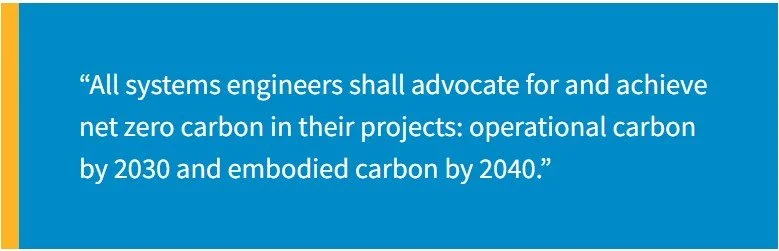
Establish a company plan to reduce operational and embodied carbon across MEP systems on all projects, targeting zero by 2040.
Request low-GWP refrigerant availability when designing systems to reduce or eliminate GHG emissions from refrigerants.
Request Environmental Product Declarations (EPDs) in project specifications for MEP system components.
Participate in a quarterly MEP 2040 Forum and MEP 2040 working groups to share lessons learned and contribute to a growing body of knowledge.